Description and Details
A rare matching set of three Dutch wool needlework chair seat covers, signed “Kyt” and dated 1840. They have never been mounted as seat covers and retain their uncut ground with wide, unworked foundation margins. The embroidered faces show no signs of use.
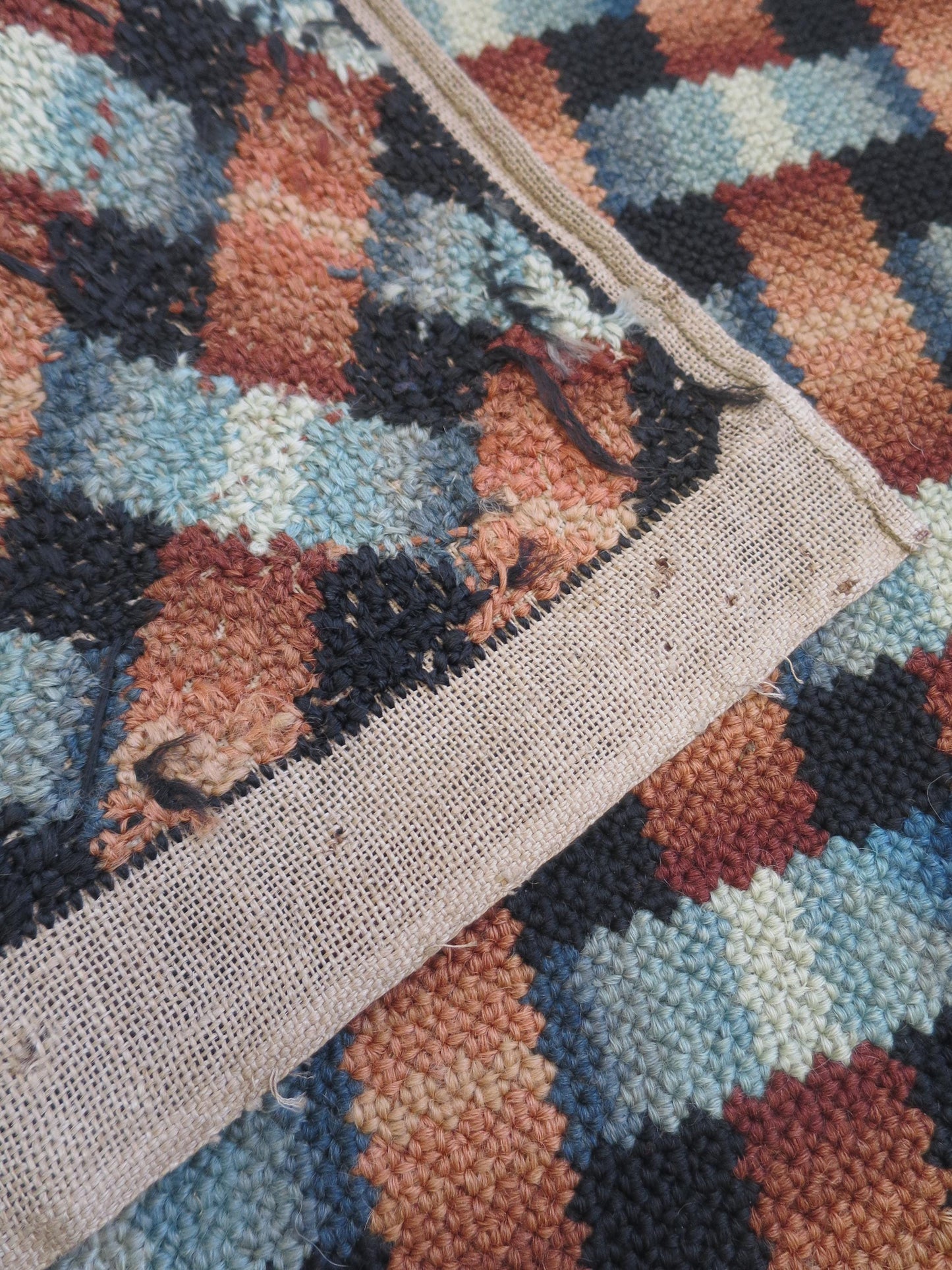
Each cover has a trompe-l’œil design of interlaced architectural strapwork or braided basketweave. Closely and evenly worked wool canvas embroidery creates the illusion of overlapping bands, using brick red, burnt ochre, slate blue and deep teal against a dense black ground. The colours remain crisp and vibrant.
Cross-stitched into the unworked margins is the inscription “Kyt … M.A … inde 1840”. The name “Kyt” is identified as a nineteenth-century Dutch diminutive of Katarina, or Katherine, accompanied by the initials M.A. The Dutch wording records the year 1840. This personal inscription connects the set to its maker and to nineteenth-century Dutch domestic needlework traditions, although it does not by itself establish the circumstances of its commission.
The worked fields are trapezoidal, tapering towards the top, and shaped for drop-in or slip-seat chair frames. Their form belongs to the furnishing traditions associated with Biedermeier, William IV and early-Victorian interiors. The three matching covers could be mounted on suitable chair frames, used for a pair of chairs and a coordinating footstool, or preserved together in conservation framing. Any proposed reuse should take account of their age and retain the signed margins wherever possible.
Historical tack marks and straight indentations from stretching remain visible in the wide, unworked linen-type ground. The positioning of the tacks and the fact that the ground remains uncut indicate mounting for stretching, rather than mounting as chair seats. This was likely carried out in the studio where the panels were produced. The margins are intact and stable, with light age-toning and minor rust staining from tacks, confined to the outer borders and clear of the embroidery.
The wool embroidery itself is in mint condition, with no visible signs of use. There is virtually no surface wool loss or thinning and no evidence of historic moth damage. The distinction between the stretching marks on the ground and the unworn worked surfaces is an important feature of this set.
Each cover measures approximately 68.5 × 52 cm (27 × 20½ inches), including the foundation margins. The worked area measures approximately 61.5 cm at its widest point by 49.5 cm (24¼ × 19½ inches). The materials are wool embroidery on a linen-type ground. All three are offered together.